
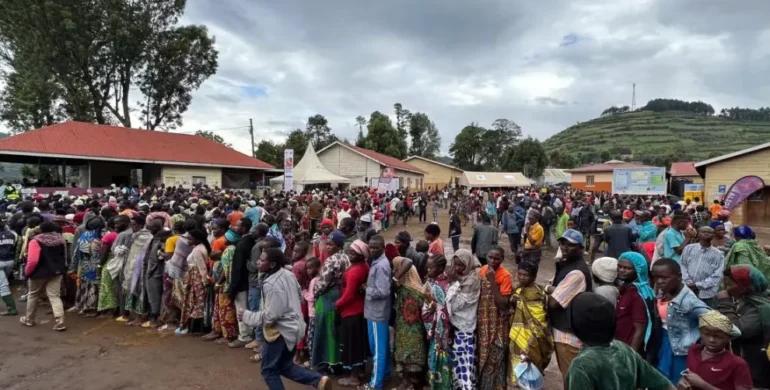
Donate to refugees in Uganda. Uganda hosts one of the largest refugee populations in the world — over 1.7 million refugees and asylum seekers, with new arrivals continuing to cross the border mainly from the DRC, Sudan, and South Sudan. Few people realize that some of the busiest border crossings for this displacement crisis sit right along the edge of the Kigezi region, where families fleeing conflict in the Democratic Republic of Congo cross into Uganda near Kisoro and Bunagana, often with nothing but the clothes on their backs.
At Kigezi Foundation, our work with vulnerable children, orphans, and struggling families naturally intersects with the refugee crisis unfolding in our own backyard. This article explains why Uganda has become a global refugee hosting hub, the specific challenges refugees face once they arrive, and the concrete ways you can help — through direct donations, healthcare support, education access, and community-based partnerships.
Why Uganda Hosts So Many Refugees
Uganda is widely recognized for one of the most progressive refugee policies in the world. Unlike many countries that confine refugees to closed camps, Uganda continues to uphold its progressive refugee policy, maintaining an open-door approach to asylum. Refugees in Uganda are granted the right to work, move freely, access public services, and are allocated small plots of land for farming in designated settlements — a model often referred to as the “self-reliance” approach.
This open-door policy, combined with Uganda’s proximity to some of Africa’s most protracted conflicts, has made it a primary destination for people fleeing violence. Refugees in Uganda come from 34 countries, with more than half arriving from South Sudan and roughly a third from the Democratic Republic of Congo, alongside smaller but growing numbers from Sudan, Burundi, and other neighboring states. In recent years, the conflict in Sudan has driven a sharp new wave of displacement, with tens of thousands of Sudanese refugees granted protection status and directed to settlements such as Kiryandongo.
While Uganda’s policy framework is admirable, the sheer scale of need has consistently outpaced available humanitarian funding, leaving gaps that local organizations and individual donors are uniquely positioned to help fill.
Refugees Along Uganda’s Southwestern Border: A Crisis Close to Home
While much international attention focuses on large northern settlements, the southwestern border region — including areas bordering Kisoro District in the heart of Kigezi — has quietly absorbed waves of refugees fleeing instability in the eastern Democratic Republic of Congo. Families cross on foot, frequently arriving with young children, elderly relatives, or unaccompanied minors, seeking safety in Ugandan border communities before being transferred to formal settlements.
For the communities Kigezi Foundation already serves, this means refugee and host-community needs are frequently intertwined. A grandmother caring for orphaned grandchildren and a refugee family newly arrived from Congo often face strikingly similar challenges: no stable income, limited access to healthcare, and children at risk of missing out on school entirely. Addressing displacement in this region cannot be separated from the broader work of supporting vulnerable families, which is why refugee support fits naturally within our existing mission. You can learn more about the populations we serve on our About page.
Border crossings near Kisoro tend to see sudden, unpredictable spikes tied directly to flare-ups of violence in the eastern DRC’s Kivu provinces. A single week of fighting hundreds of kilometers away can translate into dozens of families arriving on foot at a Ugandan border post within days, with no prior warning and no time to plan. This unpredictability is precisely why flexible, locally present support is so valuable — unlike large-scale humanitarian pipelines, which can take weeks to mobilize, an organization already rooted in the region can often respond within hours.
The Everyday Challenges Refugees Face in Uganda
Despite Uganda’s relatively welcoming legal framework, daily life for refugees remains extremely difficult. Common challenges include:
- Severe underfunding of humanitarian assistance. Food rations, cash assistance, and shelter support are frequently reduced due to funding shortfalls, leaving refugee families to fill the gap through informal labor or aid from local organizations.
- Limited access to healthcare. Many settlements and border communities lack adequate clinics, medication, and specialized care, particularly for maternal health, chronic illness, and mental health support following trauma.
- Disrupted education for refugee children. While refugee children access primary school at a far higher rate than secondary school, secondary enrollment for refugees drops sharply, meaning many adolescent refugees are effectively locked out of continuing their education past the early years.
- Water, sanitation, and hygiene gaps. Many settlement and border areas struggle with basic infrastructure, contributing to disease outbreaks and daily hardship for families already coping with displacement trauma.
- Land and livelihood pressure. As refugee numbers grow, the small plots of land allocated for farming shrink, making the self-reliance model increasingly difficult to sustain without additional support.
- Psychological trauma. Many refugees, especially those fleeing armed conflict and sexual violence in eastern DRC, arrive with significant unaddressed trauma, with very limited access to mental health services.
These overlapping pressures mean that even a well-intentioned national policy cannot, on its own, guarantee refugees a dignified life — sustained support from organizations and individual donors remains essential.
How Kigezi Foundation Supports Refugee and Displaced Communities
Kigezi Foundation’s programs are designed around the needs of vulnerable people in our region — a category that increasingly includes refugee families alongside orphans and impoverished host-community households. Our relevant initiatives include:
- Healthcare outreach, providing medical camps and health support to vulnerable individuals and families, including displaced populations in border communities.
- Education access support, helping cover school fees and scholastic materials for children regardless of displacement status, so refugee children are not left behind their host-community peers.
- Community integration efforts, working to reduce tension and build cooperation between refugee and host-community families who often share the same overstretched schools, clinics, and water points.
- Emergency and basic-needs assistance, distributing essentials to families facing acute hardship following displacement.
- Volunteer-driven outreach, mobilizing medical and community volunteers to extend our reach into underserved border areas.
You can see our current active initiatives, including our Healthcare Outreach in Kigezi Region project, on our Projects page.
Healthcare Outreach: A Lifeline for Displaced Families
Our Healthcare Outreach in Kigezi Region program runs medical camps and provides direct health support to vulnerable communities and individuals — a category that increasingly includes refugee families in border areas with little or no access to formal clinics. For a mother who has just crossed the border with young children and no documentation, a mobile medical camp offering basic treatment, screening, and referrals can be the difference between a manageable illness and a medical emergency.
Because refugee and host-community needs are so deeply intertwined in border districts like Kisoro, this program is intentionally inclusive — support is extended based on need, not legal status. To directly fund healthcare outreach that reaches displaced families, visit our Donate page.
Keeping Refugee Children in School
Displacement is one of the most disruptive events in a child’s education, often resulting in years of lost schooling even when a family eventually finds physical safety. While the vast majority of refugee children in Uganda are enrolled at the primary level, secondary school enrollment for refugees remains far lower than for the national population, meaning the risk of a refugee child’s education stalling permanently increases sharply once they reach adolescence.
Kigezi Foundation’s education programs, originally built to support orphaned and vulnerable children, extend naturally to displaced children living in our operating area. Covering school fees, uniforms, and scholastic materials removes one of the largest barriers keeping refugee children out of the classroom, giving them the same chance at continuity and stability that we provide to orphaned children in our core programs. Learn more about our broader education work on our Projects page.
Vocational Training as a Pathway to Self-Reliance for Refugees
Uganda’s self-reliance model for refugees is built on the idea that displaced people should have the right to work and build sustainable livelihoods, not remain permanently dependent on aid. Vocational and technical training plays a critical role in making that vision achievable, particularly for young refugees and host-community youth alike who need practical, marketable skills to enter the workforce quickly.
Our partner Kenlink Institute (KCI Institute), a proud sponsor of Kigezi Foundation, offers certificate, diploma, and short-course programs in fields such as tourism, hospitality, business, and skilled trades. These practical training programs are especially valuable for displaced young people who may have interrupted academic records but still need a fast, credible route into stable employment. By connecting displaced and vulnerable youth with real vocational qualifications, we help turn Uganda’s self-reliance policy from an aspiration into a practical reality.
Tourism with Purpose: How Safaris Support Displaced and Vulnerable Communities
The Kigezi region’s extraordinary natural beauty — including its proximity to Bwindi Impenetrable Forest and Mgahinga Gorilla National Park — draws travelers from around the world. Our partner Pick and Transfer Safaris, a Uganda and Rwanda safari operator, channels a portion of its tour profits directly toward supporting Kigezi Foundation’s community programs, including initiatives that reach vulnerable and displaced families in border areas.
For travelers planning a gorilla trekking safari near Bwindi or Mgahinga, often just a short distance from active refugee crossing points, choosing a community-linked operator means your trip contributes directly to the same region grappling with displacement from neighboring DRC. It’s a rare opportunity for travel to translate directly into humanitarian impact in the very landscape being explored.
Why Local, Community-Based Support Matters for Refugees
International humanitarian agencies play an essential role in Uganda’s refugee response, but large-scale aid systems often struggle to reach the most remote border communities quickly or flexibly enough. Local organizations like Kigezi Foundation, already embedded in the communities where refugees arrive, can respond faster, adapt support to real on-the-ground needs, and build the kind of long-term trust that formal aid structures sometimes struggle to establish.
Because we already operate healthcare, education, and community programs throughout the Kigezi region, extending support to refugee families does not require building new infrastructure from scratch — it means expanding programs that are already trusted, already staffed, and already present exactly where the need is emerging. This is precisely why locally rooted, donor-funded organizations remain such a critical complement to large-scale humanitarian assistance.
Donors sometimes assume that supporting large international agencies is the only way to make a meaningful difference in a crisis of this scale. In practice, smaller, locally embedded organizations often deliver a higher proportion of every dollar directly to the people who need it, with lower overhead and far greater flexibility to respond to sudden, localized needs — such as a specific family arriving at the border with a sick child, or a school suddenly absorbing dozens of new refugee students overnight. Direct giving to trusted, community-based organizations like Kigezi Foundation complements the essential work of larger agencies, filling gaps that bigger, slower-moving systems often cannot reach in time.
Challenges That Remain in Supporting Refugees in Uganda
Despite Uganda’s welcoming policy framework and the efforts of organizations working across the region, significant challenges persist:
- Chronic underfunding. Humanitarian appeals for Uganda’s refugee response are consistently underfunded relative to need, leading to repeated cuts in food and cash assistance.
- Strain on host communities. Local Ugandan families near settlements and border crossings often share the same overstretched schools, clinics, and water sources as refugees, creating tension without additional support for both populations.
- New and unpredictable displacement waves. Ongoing instability in eastern DRC and Sudan continues to drive new arrivals, straining an already stretched system.
- Limited secondary education and livelihood pathways. Many refugee youth age out of primary-level support with no clear route into secondary school or vocational training.
- Insufficient mental health and psychosocial support, particularly for survivors of conflict-related violence and trauma.
How You Can Help Refugees in Uganda Today
There are several concrete, effective ways to support refugees and displaced families in the Kigezi region and beyond:
1. Donate directly to healthcare and community outreach. Contributions through our Donate page fund medical camps and basic-needs support reaching displaced and host-community families alike.
2. Support education access for displaced children. Help cover school fees and materials for children affected by displacement through our Projects page.
3. Fund vocational training pathways. Support a displaced young person’s access to practical, job-ready training through Kenlink Institute.
4. Travel with purpose. Book a gorilla trekking or wildlife safari with Pick and Transfer Safaris, whose tour profits help fund community programs reaching vulnerable and displaced families.
5. Volunteer your time and skills. Join medical outreach teams or community engagement efforts working directly with displaced populations in border communities.
6. Raise awareness. Share accurate, current information about Uganda’s refugee crisis with your own network — many potential donors are simply unaware of the scale of need or how directly their support can help.
Become a Volunteer and Support Communities on the Frontline
For those who want a hands-on role, Kigezi Foundation welcomes volunteers to join our medical outreach teams, engage with local and displaced communities, and support our broader humanitarian and education programs. Volunteers bring skills, energy, and direct human connection that complement our funded programs, especially in fast-moving border areas where needs can shift quickly.
If you’re interested in volunteering with our healthcare and community programs, visit our Become a Volunteer page to explore current opportunities.
Real Stories from Communities Affected by Displacement
Behind every statistic is a family who has walked away from everything they knew in search of safety. We regularly share updates from the communities we serve, including the challenges and resilience of families across the Kigezi region. Explore recent features such as our look at orphanages near Mgahinga National Park and our practical guide on 10 ways you can support orphans in Uganda right now for a closer look at the human stories behind our work in this region.
Frequently Asked Questions About Donating to Refugees in Uganda
Why does Uganda host so many refugees? Uganda maintains an open-door approach to asylum, granting refugees the right to work, move freely, and access services — a policy that, combined with proximity to conflicts in the DRC, South Sudan, and Sudan, has made it one of the largest refugee-hosting countries in the world.
Does Kigezi Foundation work directly inside refugee settlements? Our programs are rooted in the Kigezi region, where refugee and host-community needs frequently overlap, particularly in healthcare outreach and education access for children affected by displacement near the border with the Democratic Republic of Congo.
How is my donation used to support refugees specifically? Donations support programs such as healthcare outreach and education access that serve vulnerable populations in our operating area, including displaced families, based on need rather than legal status.
Can I sponsor a specific program supporting refugees? Yes. Donors can direct support toward our Healthcare Outreach in Kigezi Region project or our education initiatives through our Donate page.
How does vocational training help refugees become self-reliant? Programs through our partner Kenlink Institute provide displaced and vulnerable youth with practical, job-ready skills, supporting Uganda’s broader self-reliance model for refugees.
How can I get more information before donating? You’re welcome to reach out anytime through our Contact page.
Conclusion: Dignity, Not Just Survival, for Refugees in Uganda
Uganda’s refugee policy is often praised internationally for its openness, but policy alone cannot guarantee healthcare, education, or a livelihood for the more than 1.7 million people currently displaced within its borders. In the Kigezi region, where refugee and host-community needs overlap daily along the border with the Democratic Republic of Congo, locally rooted support makes a direct, measurable difference.
Through healthcare outreach, education access, and partnerships with organizations like Kenlink Institute and Pick and Transfer Safaris, Kigezi Foundation is working to ensure that displacement does not mean permanent hardship — for refugees or for the host communities standing alongside them.
Whether you choose to donate, volunteer, fund a specific project, or travel with purpose, your support helps turn Uganda’s open-door policy into real, lived dignity for families who have lost everything but their determination to rebuild. Visit Kigezi Foundation today and help extend that support where it’s needed most.